Since last year, FTE also has a Working Group Operation. The group elected Emil Radomski from PKP Intercity and Filip Zucker from METRANS Rail as leaders to underline that both passenger and freight perspectives matter. We sat down with them for an interview to learn more about them and their work.
Please introduce yourself and give a one-sentence summary of your company and role.
Filip Zucker: “I work as a system specialist at METRANS Rail – one of the biggest Czech freight RUs. Our focus is combined transport and we provide our services in several European countries.”
Emil Radomski: “I work as a Supervisor International at PKP Intercity. We are the Polish national long-distance passenger carrier, serving as a hub for cross-border connections in Central and Eastern Europe, and my role focuses on overseeing the operational stability of our international train services.”
What are the top one or two operational challenges your company faces today?
Filip Zucker: “What we fight with very often are capacity constraints on key corridors – especially in cross-border sections due to infrastructure limitations and frequent TCRs.”
Emil Radomski: “First, the classic challenge remains punctuality: while it may not sound original, fighting for every minute in a dense network is our daily reality. However, our most dynamic challenge is managing the ‘Renaissance of Rail’. We are experiencing a sudden, massive surge in passenger popularity. Operationally, this means we are constantly stretching our resources to maximize capacity and rolling stock availability to meet this record-breaking demand.”
What does a typical day look like for you as being involved in train operations? What is one thing most people outside railways would not expect about your job?
Filip Zucker: “I am actually not directly working with operations, but I am a part of the operational department where I closely cooperate with colleagues from operations. I think people outside railways have very little idea about how the traffic is managed and how much complexity is behind the whole process. Any delay, restriction or incident may have far-reaching consequences. I also believe people do not realise how much responsibility the dispatchers have on their shoulders.”
Emil Radomski: “A typical day is a constant balancing between the theoretical plan and the operational reality. It involves monitoring the pulse of international corridors and reacting instantly when a connection is at risk.
What most people don’t expect is the sheer amount of effort and time required to handle a single breakdown. It involves a vast chain of people caring for that train – from dispatchers and train crews to infrastructure staff and technical facilities. When a train has a technical issue, it is never left unattended or handled by just one person; there is always a coordinated team working behind the scenes to ensure the train and its passengers are taken care of.”
How do those challenges differ between freight and passenger operations?
Filip Zucker: “In freight traffic, international trains that travel great distances are dependent on many different pieces of puzzle (like terminal slots, last-mile access etc.), where missing just one piece can affect the whole logistics chain.”
Emil Radomski: “My background is actually in freight. When I switched, I was told I was simply swapping 'flat wagons for wagons with windows' which turned out to be a massive oversimplification. I expected differences, but the operational stress took me by surprise. A freight train with coal can wait on a side track without complaint. Passenger traffic is a living organism where we must solve problems 'here and now.' The spectrum of situations is incomparable to freight: we deal with everything from a lost suitcase, through the stress of a missing child, all the way to tragic fatalities. Each passenger brings a unique human situation that simply cannot be put on a siding.”
How do you expect the Capacity Regulation to affect your internal processes or day-to-day operations?
Filip Zucker: “After the Regulation is adopted, we expect that it should improve the conditions for RUs. That is dependent on how consistently the Regulation will be implemented across member states. What I expect is an overall improvement in communication tools and processes, more reliable and predictable capacity and TCR planning and improvement in daily traffic management with clearly defined scenarios and processes. In the process of implementation, it is also possible that the workload will temporarily increase during the transition before the long-term benefits really show.”
Emil Radomski: “I hope it will encourage us to work together on a European scale, not just with our neighbours. Digital tools will help thousands of railway workers. Also, better planning will make passengers trust us more. We need good European solutions for capacity and crisis management.”
When you are coordinating cross-border traffic, what is the one thing that always seems harder than it should be? (Subtly highlights pain points that EFTM/Capacity Regulation can address - unified tools, language barriers, communication inefficiencies)
Filip Zucker: “Real-time coordination across borders. Information flow is not always synchronized and different systems are often not able to communicate with each other. Here I think the Regulation may bring an improvement with more harmonised and interoperable digital tools.”
Emil Radomski: “Communication. Despite everyone's good intentions, I find the persistence of national languages in international traffic incomprehensible. We should take an example from aviation and adopt a single standard language like English. Currently, even the best translation tools do not fully meet the expectations of railway staff.
Using one 'established' language would change everything. After all, operationally we all speak the same 'railway language,' yet language barriers remain. Aside from communication, infrastructure and regulatory differences are equally significant burdens.”
How can FTE best support your company during Capacity Regulation implementation (e.g., workshops, templates, working groups)?
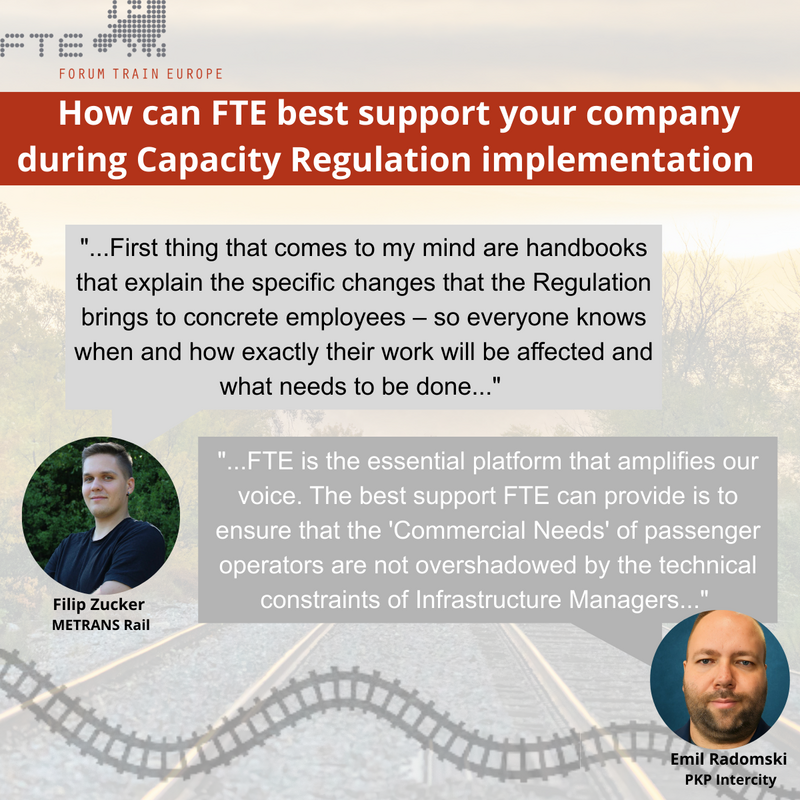
Filip Zucker: “The first thing that comes to my mind are handbooks that explain the specific changes that the Regulation brings to concrete employees – so everyone knows when and how exactly their work will be affected and what needs to be done. But more importantly, our work with FTE continues – here we can directly affect the implementation process in order to create the best possible conditions for the market.”
Emil Radomski: “As the leader of the FTE Passenger Traffic Working Group, my primary goal is safeguarding the interests and rights of the carriers.
FTE is the essential platform that amplifies our voice. The best support FTE can provide is to ensure that the 'Commercial Needs' of passenger operators are not overshadowed by the technical constraints of Infrastructure Managers.”
If you could give one piece of advice to policymakers or regulators who are designing these new rules, what would it be?
Filip Zucker: “It is difficult to provide a concrete piece of advice, since policymakers do not create the rules just by themselves, but also in cooperation with the market, IMs and other entities. My advice would be to listen to the market players – they know their operational needs best and since our goal is to improve cross-border traffic, make railway transport more competitive and stop the modal shift towards road transport, the focus should be on making the conditions for RUs fair and predictable.”
Emil Radomski: “Total simplification of the basics. No other industry, when planning its operations, is burdened by such a vast number of guidelines and dependencies, from crew rostering to strict route planning and station stops.
We need to cut through this complexity. Of course, safety remains paramount and non-negotiable, but the administrative process itself must become as straightforward as it is in other transport modes. We should not complicate what can be simple.”
Five years from now, what does success look like for cross-border rail traffic management in Europe?
Filip Zucker: “Harmonised and reliable digital tools, harmonised planning processes, improved data exchange and coordination between stakeholders and, of course, conditions that enable growth in cross-border traffic. Even if some aspects may not be initially perfect, effective performance review should let us detect inefficiencies and change/improve things swiftly if needed.”
Emil Radomski: “Success means better communication and networking between carriers. We need to work together more. Carriers should help write the EU rules, not just follow them. A strong voice for carriers is key to building a better railway sector for everyone.”